
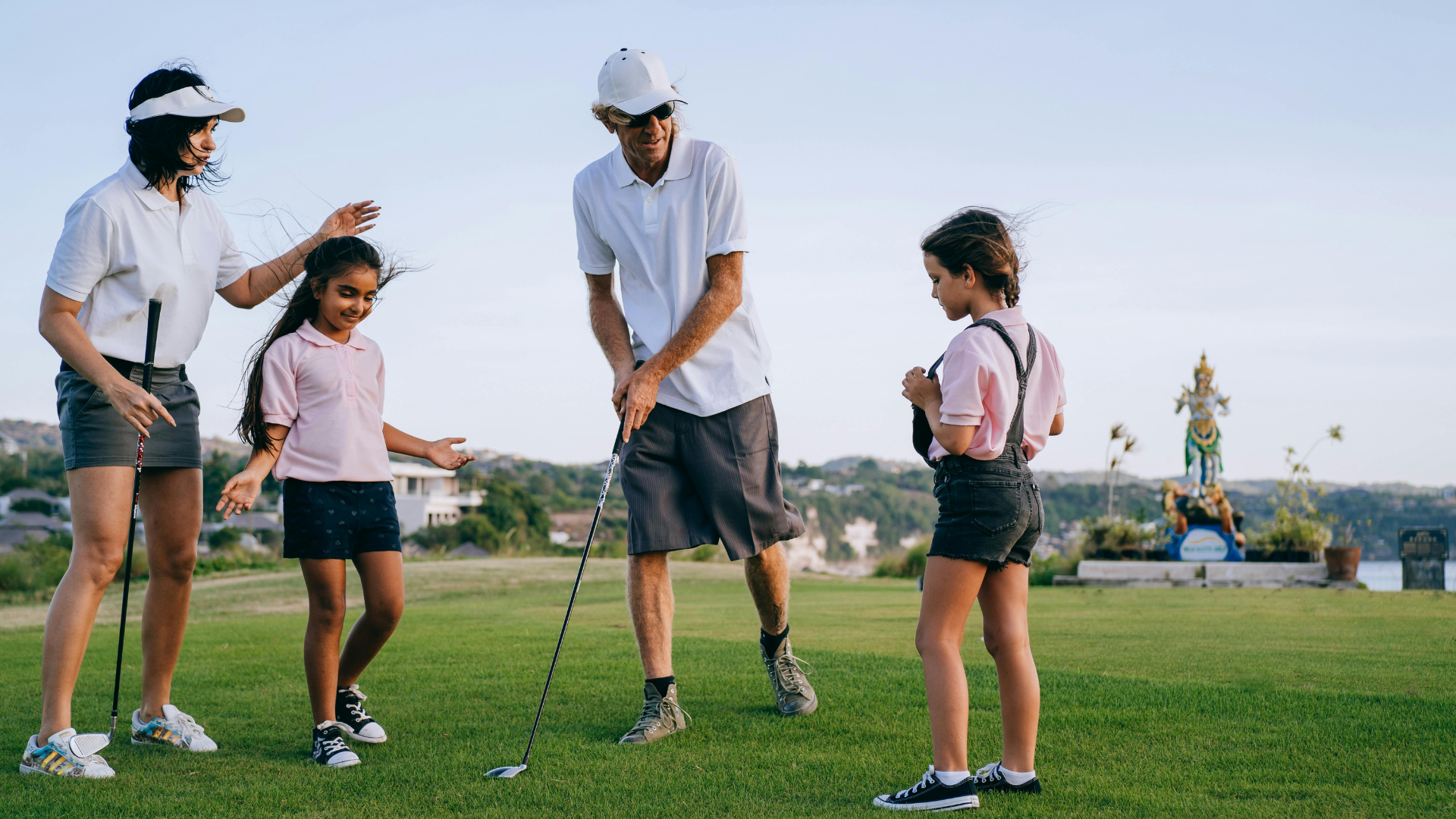
On a driving range somewhere in Europe, a child stands slightly too far from the ball.
A parent watches from behind the rope, unsure whether to correct the stance or simply let it be. A coach gives instructions in short bursts. Another child laughs somewhere nearby after sending a ball wildly off target.
Nothing about the scene suggests elite sport. And yet, in that moment, something far more significant is unfolding.
For thousands of families across Europe, golf is no longer just a weekend activity. It is becoming part of a shared family experience. This broader shift is explored in our perspective on golf for families in Europe.
The challenge is that very few parents are actually told how this journey is supposed to work.

A Game That Looks Simple. Until You Try to Guide It
To the outside observer, golf appears straightforward: you take a club, you hit a ball, you try to improve.
But for parents entering the world of junior golf, the reality is far more complex.
There is no single pathway. No unified system across countries. No shared definition of what “progress” should look like at different ages.
In some places, children are introduced through casual group sessions. In others, they are placed into structured coaching environments almost immediately. Competition begins early in some systems, later in others.
The result is a fragmented landscape.
And parents are left to interpret it in real time.
The First Years: Where Everything Is Decided Quietly
Between the ages of five and eight, most children who take up golf are not learning the game in any technical sense. They are forming a relationship with it.
Some will associate golf with pressure. Others with freedom. Some with friendship. Others are frustrated.
What matters most in this phase is not swing mechanics, but emotional context. Yet this is often where a subtle mistake is made.
Many families, eager to support progress, unintentionally accelerate structure too early, resulting in more correction, more expectations, and more focus on performance than experience.
The irony is that at this stage, retention matters more than development. Because a child who enjoys the environment will stay.
A child who feels evaluated too early often will not.
The Middle Phase: When Golf Starts to Become “Real”
Between roughly ages eight and twelve, the game begins to shift. Coaching becomes more structured. Practice becomes more intentional. Children start to compare themselves with their peers. This is where golf begins to either take root – or slowly fade.
It is also where parental involvement becomes more complicated. Parents are no longer just spectators. They become part of the development system whether they intend to or not.
They interpret progress. They manage expectations. They decide how much pressure is appropriate.
And because there is no standardised framework across Europe, most are doing this without clear reference points. Two children of the same age in different countries may be on completely different trajectories, without either parent realising it.
The Transition Years: Where Identity Forms
From around age twelve onward, something more fundamental begins to happen. Golf is no longer just an activity.
For those who stay engaged, it starts to become part of their identity. Children begin to understand competition, not just participation. They see improvement over time. They start to define themselves relative to others in the game.
But this is also where many drop out. Not necessarily because of lack of talent, but because of fragmentation in experience. Training, competition, and social belonging often exist as separate worlds.
A child may train in one environment, compete in another, and feel socially disconnected in both.
What Most Parents Are Never Told
Across Europe, one truth consistently emerges in conversations with families navigating junior golf. They are not lacking access. They are lacking structure. Specifically:
- A clear sense of progression
- A shared understanding of development stages
- A community of other families on the same journey
- Continuity across time and, increasingly, across borders
Without these elements, even well-intentioned support can feel uncertain. And uncertainty is often what leads families to disengage – not from sport itself, but from the system around it.
The Missing Layer: Environment
When junior golfers succeed long-term, it is rarely because of a single factor like coaching quality or practice volume. It is because of the environment. Environment includes:
- Who the child trains with
- How progress is understood
- Whether friends are part of the journey
- Whether parents feel connected or isolated
In other words, golf development is not purely technical. It is social. And social structures in junior golf across Europe remain surprisingly underdeveloped.
Why This Matters More Than It Seems
At first glance, junior golf development might appear like a niche concern. But it sits at the centre of a much larger system. Because every long-term golfer begins here. And every family that stays engaged contributes not just to participation numbers, but to the cultural future of the sport.
When junior environments work well, they produce:
- Retention
- Confidence
- Continuity
- Lifelong participation
When they don’t, the result is predictable: dropout, fragmentation, and missed potential.
A Shift Already Underway
Despite the structural gaps, something is changing. Across Europe, more families are beginning to think differently about how they approach golf development. Not as isolated lessons or seasonal coaching blocks—but as a continuous journey shared between parents, children, and other families in similar situations. They are beginning to look for:
- Clarity
- Progression
- Community
- Connection across borders
Not just access to golf, but a way to understand it together.
From Instruction to Connection
The most effective junior environments today are quietly shifting away from purely instruction-based models. They are becoming something else. Less transactional. More relational. Less focused on isolated performance. More focused on shared growth.
Because when children feel part of something larger than themselves, their relationship with the game changes. And when parents feel supported by a wider community, their ability to guide that journey improves significantly.
The European Reality
Unlike more centralized systems like USA, Europe does not have a single development pathway for junior golf. This creates both complexity and opportunity. Complexity, because parents must navigate different approaches depending on where they live or travel. Opportunity, because it opens the door to something new:
A cross-border network of families who are all navigating the same journey—but without a shared platform to connect them.
Where This Leads
If junior golf in Europe continues on its current trajectory, the next decade will not be defined by a lack of interest. It will be defined by how well the ecosystem supports continuity.
Families will increasingly seek environments that:
- Connect development stages
- Provide social belonging
- Create consistency across locations
- Bring parents into a shared understanding of progress
And the most successful systems will not necessarily be the most technical. They will be the most connected.
A Shared Journey Begins to Take Shape
For many families, the realisation comes slowly. That raising a young golfer is not just about coaching decisions or practice schedules. It is about the environment in which those decisions sit. And increasingly, that environment is not confined to one club, one city, or one country. It is becoming something broader.
- A network of families.
- A shared experience across Europe.
- A new way of thinking about how young golfers grow into the game.
An Open Ending
There is no single formula for raising a young golfer. But there is a growing awareness that families do not need to navigate it alone. As more parents begin to share experiences, compare journeys, and connect across borders, junior golf is slowly becoming something more coherent than it has ever been.
Not simpler. But more connected.
And for many families, that may be the difference between a passing activity…
and a lasting part of life.
Families engaging with junior golf today are not just thinking about lessons or competition – they are beginning to look for connected environments where development, community, and shared experience come together.