
Golf for Families in Europe: The Quiet Shift That Could Reshape the Game
On a mild Saturday morning somewhere in southern Europe, the first tee looks familiar.
A few early players are already walking off the green. A group of men in their 50s discuss handicaps and last week’s competition. A marshal checks the tee sheet.
And then, almost unnoticed, a different kind of group arrives.
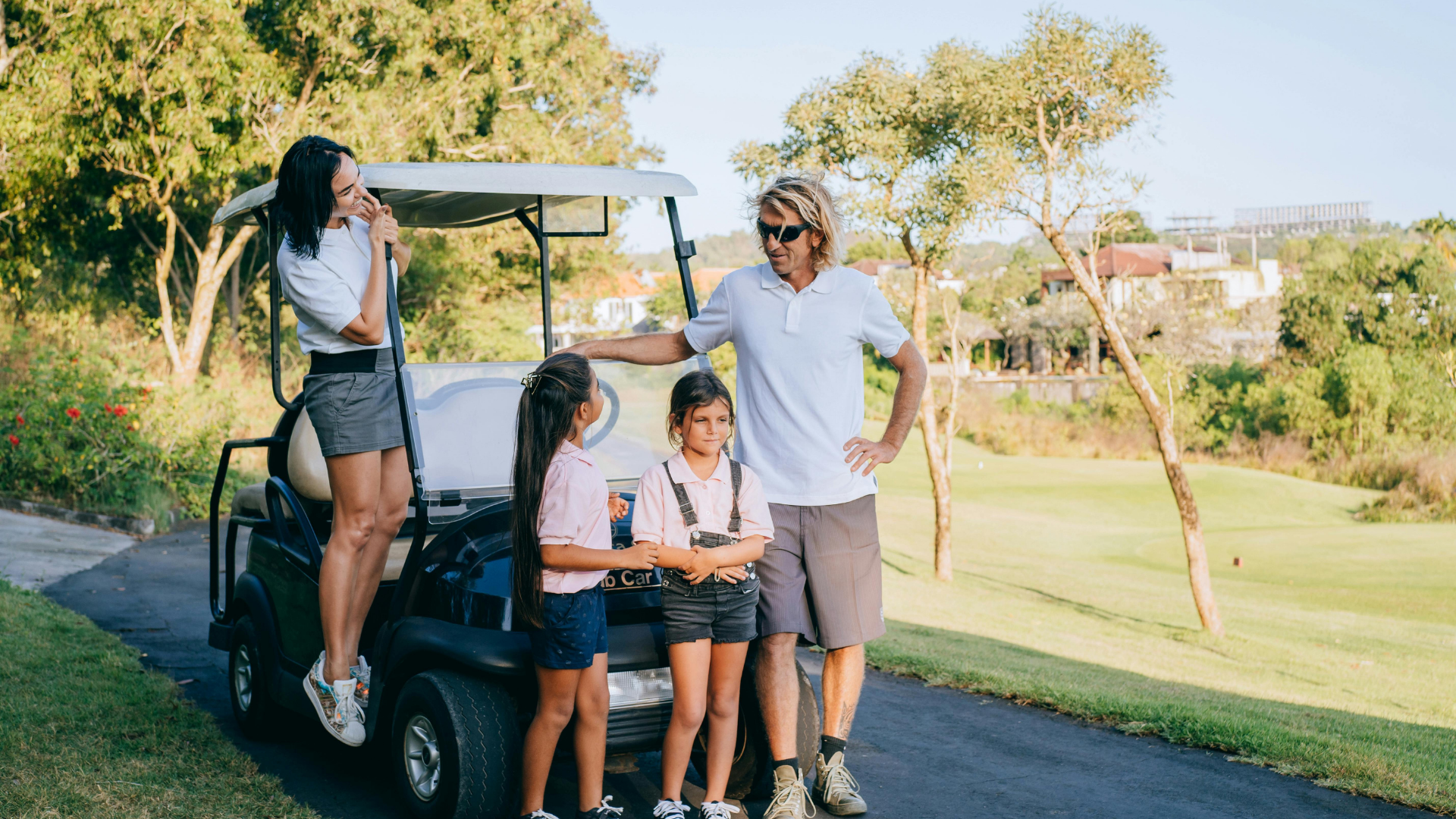
A father carrying two bags. A mother with a coffee in hand. A child dragging a half-sized set of clubs, still too big for their height but already part of their identity.
They are not in a hurry. They are not here for a scorecard.
They are here for something else.
For most golf clubs, this scene is still peripheral—an exception to the rhythm of the day. But across Europe, it is becoming increasingly common. And more importantly, it signals a shift that the industry has yet to fully understand.
Because what’s arriving is not just a new type of player. It is a new unit of participation: the family.

An Individual Game Meets a Collective Reality
Golf, by design, has always been structured around the individual.
Memberships are sold per person. Competitions are played individually. Progress is measured through personal improvement. Even the social fabric of clubs has historically been built around peer groups, often segmented by age, skill, or routine.
This model has worked for decades.
But it was built for a different era.
Today, across Europe, family life looks different. Time is more fragmented. Leisure is more intentional. Parents are more involved in how their children spend their time, not just logistically, but developmentally and socially.
Sport is no longer just an activity. It is a choice about environment, values, and community.
And in that context, golf is being reconsidered not as a solitary pursuit, but as something that can be shared.
The Signal Beneath the Surface
The data points, taken individually, don’t appear revolutionary.
Junior programs are growing in many regions. Coaching academies are reporting increased demand. Golf tourism is expanding to include multi-generational travel. More clubs are experimenting with family-oriented events.
But taken together, they point to something more structural. Parents are not just introducing their children to golf. They are trying to integrate golf into family life. And that changes the equation entirely.
While the broader shift toward family-based golf is becoming visible across Europe, many parents are still navigating the more practical question: how to actually support a child’s development in the game. A deeper breakdown of this journey is explored in our guide to raising a young golfer in Europe.
Because a family does not engage with golf in the same way an individual does.
- They don’t optimize for tee times, they optimize for time together.
- They don’t measure value purely in rounds played, they measure it in experiences shared.
- They are not looking for access, they are looking for belonging.
Where the Model Starts to Break
Despite this shift, most of the golf ecosystem still treats families as a collection of separate users.
- A child is enrolled in a junior program.
- A parent holds a membership – sometimes.
- Another parent participates occasionally, or not at all.
Each interaction is managed independently.
What’s missing is continuity.
There is rarely a framework that connects these experiences into something cohesive. No shared journey. No structured pathway that includes both development and community. No network that extends beyond the boundaries of a single club.
The result is subtle but significant – engagement becomes fragile.
Children drop out when motivation fades. Parents disengage when the experience feels transactional. Clubs struggle with retention, often without fully understanding why.
It is not a lack of interest in golf. It is a lack of integration around it.

Why Families Behave Differently
In most industries, the most valuable customers are not individuals, but households.
- They stay longer.
- They spend more over time.
- They influence others.
Golf is no different—except that it has been slow to organize itself around this reality.
A family that commits to golf is not making a seasonal decision. It is making a multi-year investment.
- In coaching.
- In equipment.
- In travel.
- In time.
But more importantly, it is investing in a shared experience. And shared experiences tend to endure.
A European Fragmentation and Opportunity
Nowhere is this more relevant than in Europe.
Unlike more centralised markets, European golf is inherently fragmented—across languages, cultures, and national systems. A family that moves from one country to another, or even travels regularly, often finds itself restarting its golf experience from scratch.
- New club.
- New network.
- New routines.
Continuity is lost.
And yet, these same families are among the most mobile, connected, and internationally minded groups in the game. They are, in many ways, already operating as a pan-European community.
What’s missing is the infrastructure to support it.
From Club to Network
This is where the shift becomes more than operational. It becomes conceptual. Because once families begin to connect – not just within a club, but across clubs and countries – the role of golf starts to expand.
It becomes:
- A social connector
- A developmental environment
- A platform for relationships that extend beyond the course
Children form friendships that are not limited by geography. Parents build connections that are both personal and professional. Travel becomes part of the experience, not an exception to it. In this model, golf is no longer defined solely by the round. It is defined by the network around it.
An Expansion, Not a Replacement
None of this suggests that traditional golf structures are becoming obsolete.
Far from it.
The core of the game – competition, discipline, individual mastery – remains unchanged. And for many players, that will always be the primary appeal. But alongside that core, something new is taking shape.
A parallel layer of engagement.
One that is less about individual performance and more about shared experience. Less about access, and more about connection. And crucially, one that brings more people into the game, not fewer.
The Shape of What Comes Next
The golf industry has long debated how to attract the next generation of players. But the more relevant question may be different.
Not: How do we bring more individuals into golf?
But: How do we support the families who are already trying to build their lives around it?
Because they are already here.
- Arriving quietly.
- Organising informally.
- Creating their own versions of what the experience should look like.
What they lack is not intent. It is a structure.
A Network in the Making
Across Europe, a new kind of golf community is beginning to emerge – one built around families who share a common rhythm: raising children in the game, navigating development pathways, and looking for others on the same journey. They are not defined by one club, or even one country. They are defined by a shared perspective.
That golf, at its best, is not just played, it is lived—together.
Where This Leads
If this shift continues (and there is little reason to believe it won’t) the implications are significant.
- For clubs, it offers a path to deeper engagement and long-term retention.
- For the industry, it opens a broader and more resilient growth model.
- For families, it transforms golf from an activity into a meaningful part of life.
But for now, it remains early. Which is often where the most interesting opportunities are found.
An Open Invitation
For those who recognize themselves in this shift – for parents, for young golfers, for families navigating this journey – there is an opportunity to be part of something that is still taking shape.
- A network that connects golf families across Europe.
- A shared space for learning, competing, and growing.
- A new layer to the game that complements everything that already exists.
Because the future of golf may not arrive with a dramatic change.
It may arrive the way it already has—quietly, on a Saturday morning, at the first tee, as a family steps forward together.
Families engaging with junior golf today are not just thinking about lessons or competition – they are beginning to look for connected environments where development, community, and shared experience come together.